
DECKED OUT LIKE AN IMMIGRATION JUDGE, BUT THE EXECUTIONER'S EARS STILL STICK OUT.
- Gregory Duralev
- Nov 16, 2024
- 11 min read
Updated: Aug 6, 2025
Kevin W. Riley - Immigration Judge, whom, based on my own experience and online information, I would describe as an artist turned executioner under the guise of an immigration judge. His record of approximately 90% asylum denials (reaching nearly 100% in 2020, according to this online source) suggests that he could not fully grasp the meaning of the word "Judge" yet even though has been working by Judicial officer exercising the Immigration Judge duties since 2009.
It is important to note, especially for those, who unfamiliar with the structure of Immigration Courts, that Immigration Judges are not true judges in the constitutional sense of the separation of powers. They are merely hired employees of a subdivision of the Department of Justice as any other officer or soldier. Many of Immigration Judges came to their new roles after serving as counsels for Department of Homeland Security, where their duties resemble those of prosecutors in criminal proceedings but within the immigration courts. This background means that before they turned to administrative Immigration Judges their role had rather been to make it as difficult as possible for immigrants to win their cases.
As a result, many of the Immigration Judges (not all) are not able to separate themselves from "prosecutorial" mindset and embrace the neutrality expected of a true judge - even if they are an administrative judicial officers. Many still carry a prosecutor’s mindset, that, actually, demonstrates a lack of the dignity and integrity regarding their new role presupposing nuetrality and unbias from the role of judicial officer. For Judge Kevin W. Riley, his high denial rate, sometimes reaching to nearly 100%, speaks volumes.
Indeed, when you find yourself in a situation where the statistics demonstrates that the possibility of losing in the court is inconsiderably less than 100%, than the terms "Court" and "Judge" can rather resonate with the words "scaffold" and "executioner". In my opinion, Judges with denial rates approaching 100% harm the integrity of the U.S. Judicial system in the eyes of both national and international communities. Although administrative Judges are not part of the U.S. Judicial branch, the general public is often unaware of this distinction and perceives administrative Courts as integral to the U.S. real Judicial system.

One might assume that Judges have the right to discretion even though they are administrative ones. You are correct. However, we live not in a medieval kingdom. Unlike the "Rule of Man" existing in medieval monarchies, the United States upholds the Rule of Law, a principle founded by Justice Marshall as early as 1803, in a landmark decision Marbury v. Madison, 5 U.S. 137, 163 (1803), when he held:
"The government of the United States has been emphatically termed a government of laws, and not of men. It will certainly cease to deserve this high appellation if the laws furnish no remedy for the violation of a vested legal right."
That is why in the United States, presumably, "A government official has no discretion to violate the binding laws, regulations, or policies that define the extent of his/her official powers." Indians v. United States, 800 F.2d 1187, 1196, 255 U.S. App. D.C. 162 (D.C. Cir. 1986)
See also in Loumiet v. United States, 424 U.S. App. D.C. 113, 121, 828 F.3d 935, 943 (2016) the Court noted: “In Nurse v. United States, for example, the Ninth Circuit held that "[i]n general, governmental conduct cannot be discretionary if it violates a legal mandate," including a constitutional mandate. 226 F.3d 996, 1002 (9th Cir. 2000).”
As evidenced by the legal decisions cited above and aligned with common sense, government officials, including Immigration Judges, possess only the discretion explicitly granted to them by federal statutes or regulations. Therefore, there would be nothing inherently wrong with an Immigration Judge having a 100% denial rate if those denials were made in strict accordance with the law. However, based on my own experience, Immigration Judge Kevin W. Riley performed his duties in apparent defiance of the legal mandate conferred upon him by U.S. immigration law. Let’s see what I mean by reviewing what transpired during my Master Hearing.
In one of my previous posts, I explained what the Master hearing is about in Immigration proceedings. Inanutshell, during this initial hearing the Immigration Judge must determine whether the charge lodged by the immigration officers in the Notice to Appear is correct and if it is, to admit the alien as a subject of removal from the United States based on the statute of either deportability or inadmissibility. However, if the charge is not correct, in other words - the charge is not supported by clear and convincing evidence then, the removal proceedings shall be terminated.
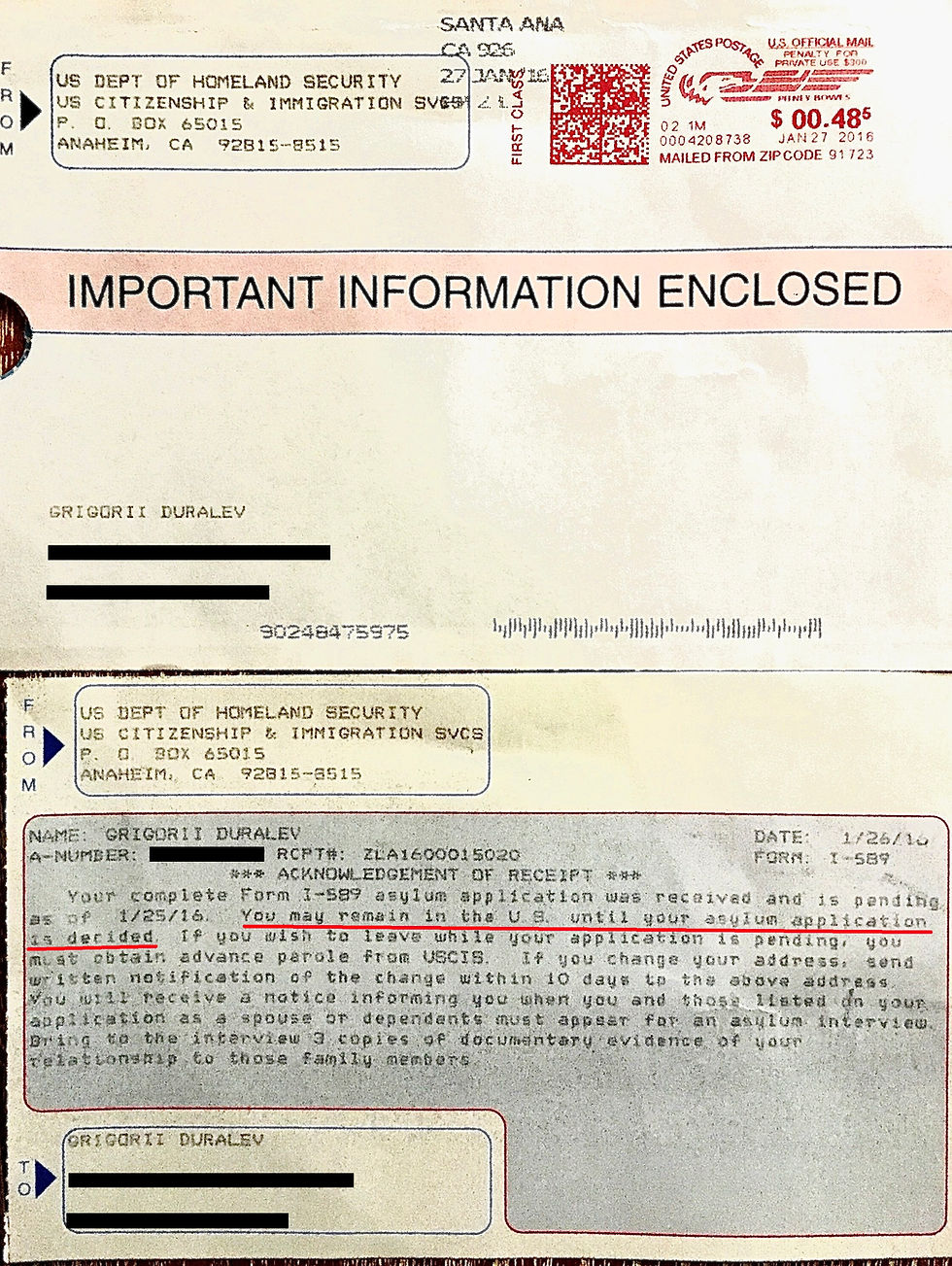
In my situation, I was administratively charged with deportability based on the ostensible remaining in the United States "for a time longer than permitted" even though I had an official, valid, written, non-revoked permission to remain in the United States issued for my name by the subdivision of the DHS - USCIS. This permission was issued because the DHS recognized me as an asylum seeker. This permission would have expired only if the USCIS had decided my asylum application I-589. When I was arrested my case was not decided and therefore, my permission was not expired. (Circumstances of my arrest I expoused in this and this - more detailed posts). My situation may be visually presented like in the picture below:

That is why, even though I was frustrated - or rather, shocked - by such a sudden and baseless arrest, I believed that the immigration officers, like in any countires, might have simply made a mistake. Nevertheless, I was confident that once I appeared before the Court, everything would become clear, as I possessed an official document that directly refuted the charge word for word. Little did I know that Immigration Judge Kevin W. Riley would demonstrate to me how the law in the United States can be disrespected when you are faced with a Judge who is professionally unfit for his role.
The Master Hearing in removal proceedings are governed by the federal statute 8 USC § 1229a and regulations 8 C.F.R. § 1240.
Immigration Judges' power and authorities to conduct removal proceedings in the Immigration Court are limited by 8 C.F.R. § 1240.1(a)(1)(iv) as to take any action consistent only with applicable law and regulations as may be appropriate. Pursuant to 8 C.F.R. § 1240.8(a) - An Alien charged with deportability shall be found to be removable only if the DHS proves by clear and convincing evidence that the Alien is deportable as charged. The determination made by the IJ shall be based only on the evidence produced at the hearing. 8 U.S.C. § 1229a (c)(1)(A). No decision on deportability shall be valid unless it is based upon reasonable, substantial, and probative evidence. See 8 U.S.C. § 1229a (c)(3)(A).
It must be emphasized that, as outlined in 8 C.F.R. § 1240.8(a), it is clear that the DHS had the burden of proving by clear and convincing evidence that I was removable from the United States. In practice, it means that the Judge except for procedural matters, should not have disturbed me by demanding from me the defense of myself during the hearing until after the DHS counsel presenting clear and convincing evidence to support the charge.
Significantly, and particularly relevant to my case, under 8 C.F.R. § 1240.10(e), the DHS may lodge additional or substituted charges of inadmissibility, deportability, or factual allegations in writing at any time during the proceedings. The individual in removal proceedings must be served with a copy of these charges and allegations. What does this mean? It means that DHS counsel cannot simply accuse you or make additional allegations verbally. They must lodge such charges in writing and properly serve you with the corresponding document.
Thus, during my Master Hearing, the only document the Immigration Judge, Kevin W. Riley, received from the DHS counsel was the Notice to Appear (incorporated below), which contained the official charge against me. No additional piece of evidence supporting the charge was presented to the Judge. You may reveal this fact from the full official transcript of the whole hearing I attached at the end of this article to support each of my words.
The official Charging document

I was represented myself at the Master Hearing. When the Judge started reading the allegation and asked me to "admit" or "decline" them, I admitted the first three allegations stating that I was not the U.S. citizen, I was citizen of Russia, and that I arrived in the U.S. under B2 visitor visa, was lawfully admitted and authorized to remain no longer than for the following six months after the arrival. However, I denied the allegation fourth and the charge in the Notice to Appear, which accuses me of remaining in the United States beyond six months without permission or authorization from the DHS because I had such a permission.
To rebut the fourth allegation and charge, I presented to a Judge an official document issued by the DHS for my name, which permitted me "to remain in the United States until my asylum application is decided" see this document below incorporated in my article. The date of receiving this permission from the DHS indicates that it was obtained much before my initial permission expired like the picture above demonstrates.
In response to my evidence, the DHS's counsel, however, claimed verbally that because I confirmed my alienage by admitting allegations first and two, purportedly, I should have had a burden to establish that I was "in lawful status."
If you are still reading the article, did you notice how rogueshly the DHS's counsel substituted the sole official charge that was "you remained for a time longer than permitted" to that I was not "in lawful status"? Moreover, he did it verbally not in writing that is mandated by 8 C.F.R. § 1240.10(e) requiring that any substituted charge must be done in writing and served to me. In other words, after observing that I had clearly refuted the sole official real charge, the DHS's counsel on the fly decided to accuse me of an entirely different charge, unrelated to the one originally lodged in the Notice to Appear.
Indeed, nothing in the charge lodged in the Notice to Appear contemplates anything relating to my "lawful status." Nonetheless, the Immigration Judge Kevin W. Riley shamelessly adopted the DHS's unlawful argument, and since that moment on, many times during the hearing, Kevin W. Riley had requested me to establish that I was in “lawful status” or that I had already granted with the asylum status, despite it is an entirely different concept of charge as Federal Court of Appeals for the Seven Circuit explained. See Chaudhry v. Holder, 705 F.3d 289, 291-92 (7th Cir. 2013) citing in re L-K, 23 I. & N. Dec. 677, 680-81 (BIA 2004) (distinguishing status and presence) (As the Board explained, however, unlawful presence and unlawful status are distinct concepts in the argot of immigration specialists. It is entirely possible for aliens to be lawfully present (i.e., in a "period of stay authorized by the Attorney General") even though their lawful status has expired.)
Moreover, the process of switching the burden of proof onto my shoulders after merely establishing alienage, as the DHS’s counsel claimed, applies only to the aliens charged with inadmissibility see the federal regulations - 8 C.F.R. §1240.8(c). Meanwhile, I was lawfully admitted to the United States as a nonimmigrant, and charged with the deportability that presupposed that the federal statutes and regulations appropriate to my hearing should have been for deportable aliens but not for inadmissible.
The process of switching the burden of proof in the way the DHS's counsel claimed and the IJ unlawfully adopted violated 8 U.S.C. § 1229a (c)(3)(A) and 8 C.F.R. §1240.8(a), which does obligate the DHS to bear the burden to prove under a clear and convincing standard that I was deportable as charged. Despite the U.S. Immigration legislation, the Immigration Judge Kevin W. Riley simply disregarded that federal statutes and entire due process with it. Along with all of these, the Immigration judge Kevin W. Riley violated the federal regulations 8 C.F.R. § 1240.1(a)(1)(iv) obligating him as to take any action consistent only with applicable law and regulations as may be appropriate. Nothing allowed Kevin W. Riley to exercise his duties on his whim or caprice.
Markedly, the Judge Kevin W. Riley did not inform the DHS's counsel on the record that he must bear the burden of proving under the standard of proof like "cear and convincing evidence" that I was departable. For such instances, the Ninth Circuit held that by failing to apply the correct standard of proof, the IJ committed a legal error and that this error was prejudicial. See Singh v. Holder, 638 F.3d 1196, 1205 (9th Cir. 2011).
However, it was not the utmost blatant illegal conduct of the immigration judge Kevin W. Riley during my Master Hearing.
Thus, when Kevin W. Riley rendered his oral decision about my removability, without being embarrassed at all, the Judge admitted that I indeed had the right to stay in the United States. By rendering that, factually, the IJ recognized that the charge in the NTA was groundless. However, the IJ continued by accusing me of not having been granted any lawful status, even though the NTA contains no such a charge.
By the IJ’s findings, it appears that the United States must deport all aliens right after they apply for any kind of the lawful status because getting approval or denial of their applications takes from months to years, and during this period, usually, aliens have only a permition to remain in the United States, but they do not have legal status.
As provided in the INA and the regulations and confirmed by the Attorney General, “[i]mmigration judges . . . possess the authority to terminate removal proceedings where the charges of removability against an Alien have not been sustained.” Matter of S-O-G- & F-D-B-, 27 I&N Dec. 462, 468 (A.G. 2018). See also Matter of Castro-Tum, 27 I&N Dec. 271, 292 (A.G. 2018). The Castro-Tum decision directed that “[c]ases that should not go forward should be terminated (either with or without prejudice), or dismissed, provided they meet the relevant legal standard.” Id.
My case clearly met the legal standard under which DHS could not substantiate their specific deportability charge in the Notice to Appear. The Immigration Judge was obligated to conduct the proceedings differently within the scope of his authority, and the outcome would have been completely different had he followed the statutes and federal regulations. However, Judge Kevin W. Riley, while performing his official duties, disregarded all applicable federal statutes and regulations.
In July of 2022 I filed a complaint against this Immigration Judge corrupted by his perception that he is above the law. My complaint filed with the Office of Chief Immigration Judge was completely ignored. The Chief Judge, as I believe, chose not to act in favor of law, but decided to cover up the violator in his department - Immigration Judge Kevin W. Riley.
So, this article is written by me following my own belief, that people of the United States should know whom they feed for their taxes. I also trully believe that exposing such an officials like Kevin W. Riley for overreaching his authority will help others who may find themselves in the same situation to understand better their rights based on the experience I share.
In my case this Judge’s unlawful conduct of the Master hearing caused me 525 days of illegal immigration detention based on administrative violation that I did not only commit but also I have never been charged with. So, Kevin W. Riley is an individual whose place is to work not in the Department of Justice in the U.S. - the country presupposed to be a country of freedom, but rather, I guess, in the Third Reich in Germany when it was under Nazists.
Why should you believe me instead of Judge? You shouldn’t, necessarily. However, you can evaluate my expertise based on the context and my achievements. I hold a Master's degree from Washington University in St. Louis School of Law (2023), and it is my third Master's degree. In April 2024, I was invited by the legislative staff of California Assemblymember Jasmeet Bains to share my perspective and advocate for state legislation designed to protect Californians from transnational repression by foreign governments. You can also review my extensive record of legislative work related to my own cases here. I have never been represented by attorneys in those proceedings. Moreover, I am attaching the transcript of my Master Hearing that supports each and every words written forth before.
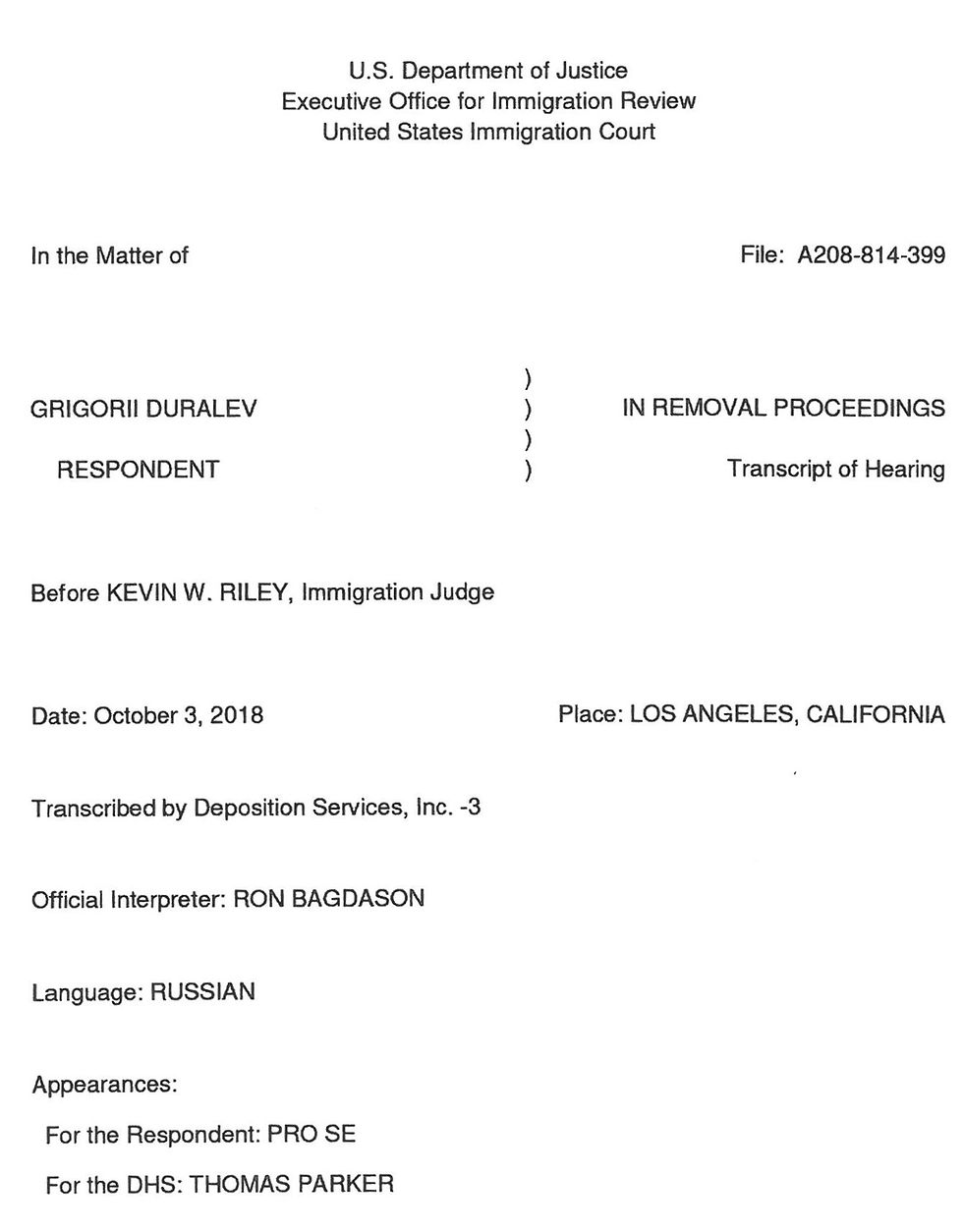
Below is the official transcript of the hearing, which demonstrates that every statement I have made regarding Immigration Judge Kevin W. Riley’s overreach of authority and his conduct in violation of the law during my Master Hearing is substantiated by this record.
TRANSCRIPT OF THE HEARING.


Comments